News
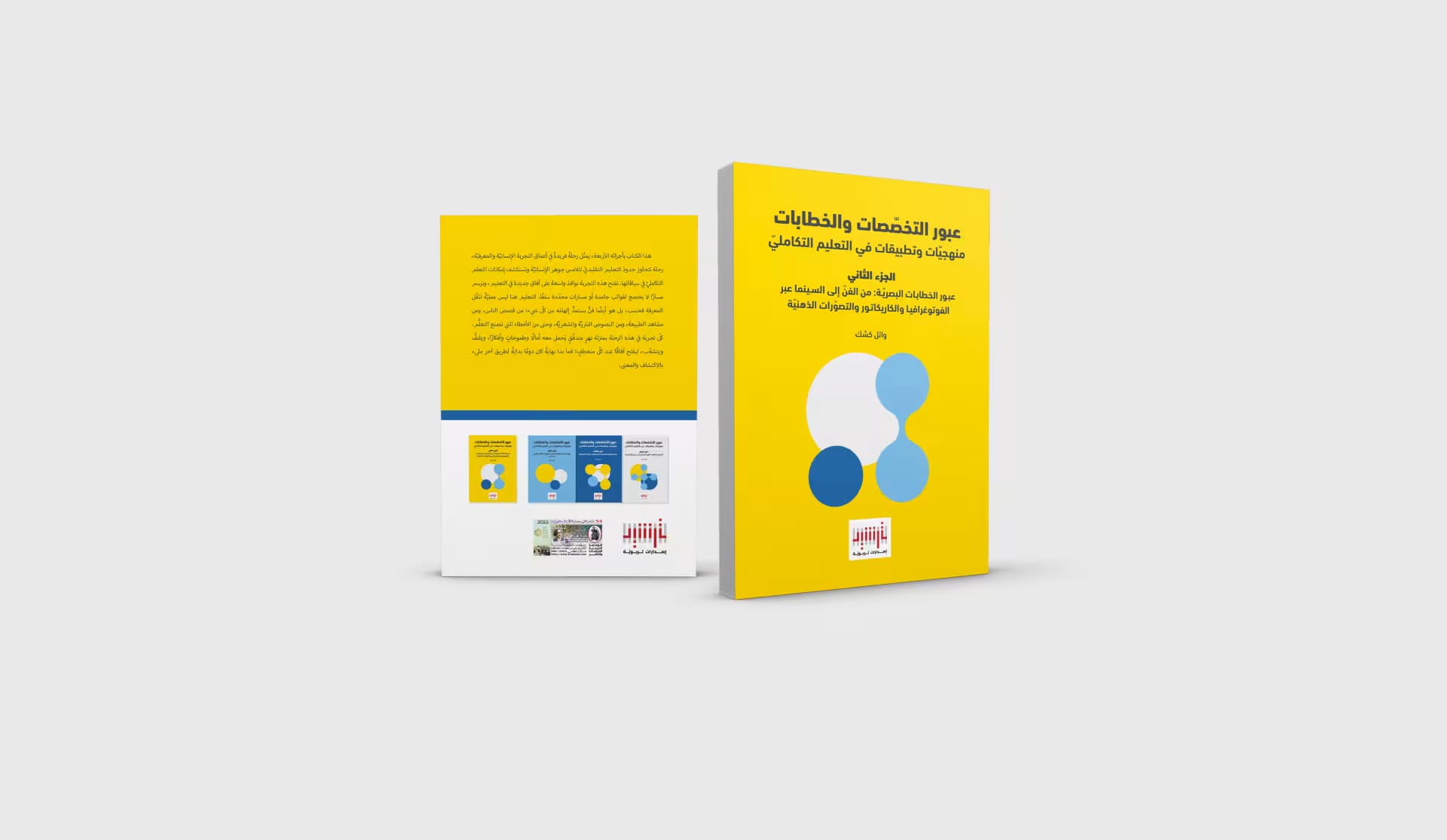
This volume serves as a comprehensive reference for the use of visual discourse in education. It combines theoretical concepts with practical applications that support teachers in delivering rich and diverse learning experiences. The volume is structured into two main sections:
Foundations and Concepts
This section includes a chapter that provides a conceptual framework upon which the rest of the content is built. It begins with integrative approaches to education, tracing the historical development of interconnected knowledge across time and into the modern era. It explores philosophical perspectives that support linking different subject areas, with a focus on achieving integration across disciplines to enhance students’ holistic understanding.
The chapter then examines the concept of discourse more broadly, with a focus on semiotics and the fundamental elements of discourse. It moves on to explore foundational concepts specific to visual discourse and its analysis. It also highlights 21st-century skills, outlining the competencies students need to navigate the challenges of the digital age. The chapter concludes with practical recommendations for teachers to maximize the benefit of the book’s content.
Crossing Visual Discourse: Educational Approaches, Activities, and Projects
This section explores five types of visual discourse across five chapters:
Artistic discourse (Chapter 2): Analyzing works by well-known artists to demonstrate how art can be integrated with subjects such as history and literature.
Photographic discourse (Chapter 3): Examining photographs to interpret visual symbols and meanings, supported by practical examples that promote critical thinking.
Caricature discourse (Chapter 4): Exploring caricature as a tool for expression and social critique, with strategies for integrating it into teaching.
Mental imagery (Chapter 5): Engaging with imaginative and conceptual representations through creative activities based on literary texts.
Cinematic discourse (Chapter 6): Exploring how films can be used as educational tools to enhance students’ critical and cultural understanding.
This volume provides teachers with a comprehensive practical framework that supports the creation of rich and integrated learning experiences. Through diverse activities and project-based approaches that cross traditional subject boundaries, it fosters students’ critical and creative thinking, supports deeper understanding of subject matter, and helps learners apply their knowledge in real-life contexts.
Overview of the Four Volumes of “Crossing Disciplines and Discourses”
Each of the four volumes can be read independently, despite their strong interconnection. The following overview illustrates the progression across the series:
Volume One: “Crossing Pathways of Critical Thinking: Methodologies of Mind and Social Awareness”
Serves as the foundational base, providing the tools and concepts needed for critical and logical analysis. These skills are essential for engaging with the subsequent volumes.
Volume Two: “Crossing Visual Discourses…”
Builds on the critical thinking skills developed in Volume One, applying them to the interpretation and analysis of visual materials such as artworks, photographs, caricatures, and films.
Volume Three: “Crossing Historical and Narrative Discourses into Educational Environments”
Focuses on applying critical thinking to historical and narrative texts, enabling deeper analysis and interpretation of events and stories.
Volume Four: “Integrated Education: An Integrative Approach across Disciplines”
Draws on the concepts and theories explored in the previous volumes to develop integrated educational projects, combining critical, visual, historical, and narrative knowledge to enhance the overall learning experience.
This second volume represents the tenth publication in the Tarsheed Educational Publications series, following titles such as A Questioning Mindset (2022), Innovative Solutions to Student Behaviour Challenges in Schools (2022), Towards an Effective Teacher in Face-to-Face and Online Learning (2022), Teachers’ Professional Practices: Between Theory and Application (2023), What Happens Inside the School? (2023), Inclusive Education for Students with Visual and Hearing Impairments (2023), Developing Practicum Programmes for Pre-Service Teachers through a Narrative Reflective Approach (2023), Concept-Based Teaching and Curriculum: For Thinking Classrooms (2024), and Crossing Disciplines and Discourses: Methodologies and Applications in Integrated Education (2024).